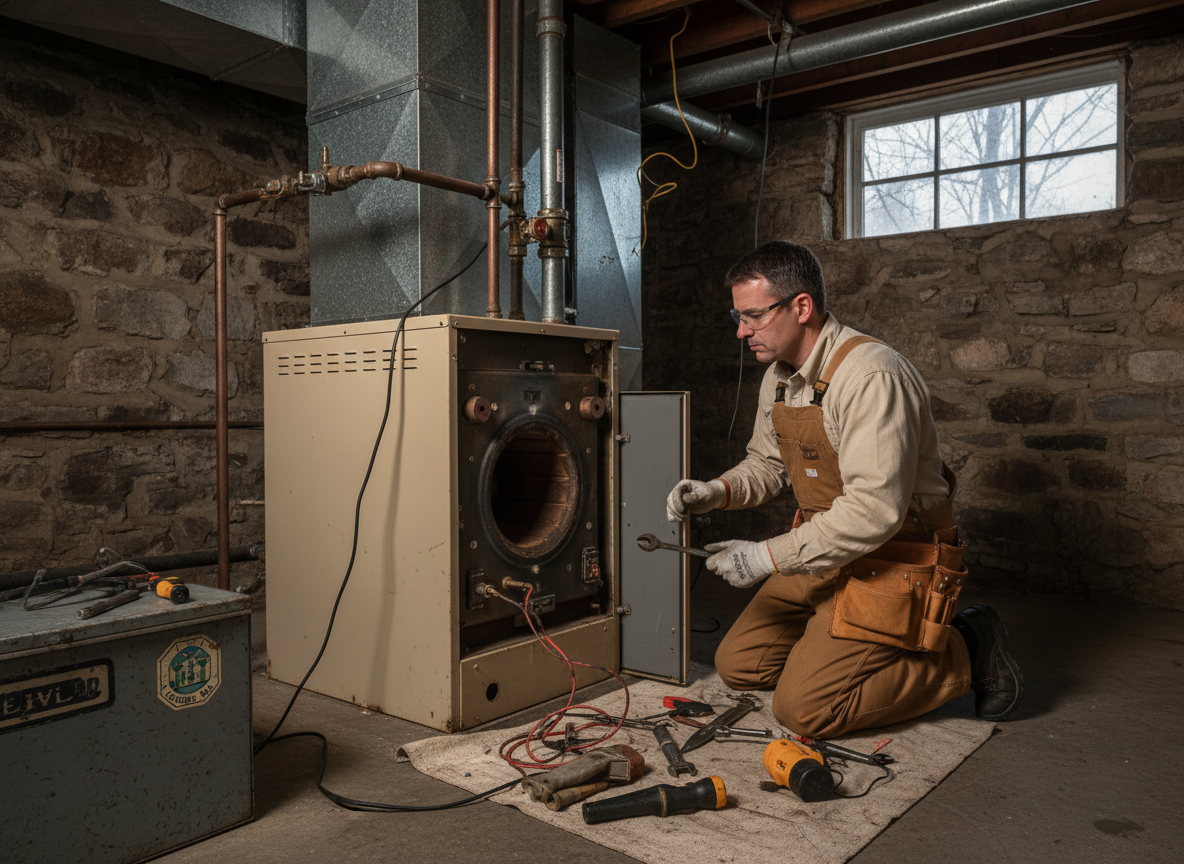
Furnace maintenance in Lowell is a before-the-season job, done while the house is still warm and a fault can be found without anyone shivering. It is an inspection, a cleaning and a set of measurements rather than a repair, and its value is in what it rules out: a flame sensor that is nearly coated, an igniter that is drawing more current than it should, a condensate trap half full of debris, a flue that has lost its draft.
What a maintenance visit is, and what it is not
A maintenance visit assumes the furnace works. It starts from a running machine, measures how it is running, cleans what has collected over the season and leaves a record of the readings. A repair starts from a symptom and works backwards to a cause. Keeping the two separate matters, because a maintenance visit that turns into a parts swap is a repair with a different label.
That distinction also sets what a maintenance visit can honestly claim. It reduces the chance of a mid-winter failure by finding the parts that are on their way out, and it keeps airflow and combustion where the manufacturer intended them. It cannot make an oversized furnace the right size, restore a crushed duct, or repair a heat exchanger that has cracked. Where the readings show one of those, the finding belongs in a repair conversation.
The checks that actually matter
The first is airflow. Static pressure across the furnace and the temperature rise across the heat exchanger say more about how a system is working than any visual inspection, and a rise outside the data-plate range points at a blower wheel that needs cleaning, a filter that is loaded or a duct system that cannot carry the air the furnace is moving.
The second is combustion. On a gas furnace that means manifold pressure, the flame pattern, the colour and shape of the flame, the position of the flame on the sensor, and the draft through the flue or the integrity of the sidewall termination. On a condensing furnace the vent slope, the condensate trap and the drain line are part of the same check, because a trap that cannot drain will shut the furnace down on a pressure switch.
The third is the ignition circuit. A hot-surface igniter that has aged draws more current and takes longer to glow, and a flame sensor that has collected oxide stops proving flame reliably. Neither shows up as a fault until it does, and both are easier to replace before the season than during it. Measuring igniter current and flame signal turns a guess into a decision.
The fourth is the safety circuit. Limits, rollout switches, the pressure switch, the door switch and the flame roll-out path are checked, not just observed. A limit that has been reset repeatedly is a symptom, not a maintenance item, and a maintenance visit that leaves one in place without explaining it has not done its job.
The fifth is the electrical side. Blower capacitor values drift, contactor points pit, and board connectors loosen in a basement that swings between damp and dry. A capacitor that has lost a third of its value will still start the motor on a mild day and fail on a cold one.
Signs the furnace is due for a visit
A dusty smell that lasts longer than the first hour of the season, heat that is weaker at the far registers than it was last year, a furnace that short cycles on mild days, a blower that is louder than it used to be, or a filter that loads within a month all point at the same short list of causes. None of them is urgent on its own, and all of them are cheaper to look at in September than in January.
What a maintenance visit includes
The visit covers the filter and return-air path, the blower wheel and motor, the capacitor, the burners and flame pattern, the igniter and flame sensor, the heat exchanger as far as it can be seen, the inducer and pressure switch, the flue or sidewall vent, the condensate trap and drain, the limit and rollout circuit, the thermostat and its calibration, and a full-cycle test with the readings recorded.
Parts that are worn but still working are reported rather than replaced on the spot, so the decision stays with whoever pays for the work. Parts that have failed are a repair, and a repair is quoted as a repair. That keeps the maintenance visit honest and keeps the record useful.
Why Lowell furnaces need this more than a mild-climate furnace
NOAA's 1991-2020 normals for the Lowell station put the normal January low at 16°F and the normal high at 34°F, with 1,243 heating degree days in January alone. That is a long, hard season for a machine that sits idle for seven months and then runs continuously for five, and it is why a marginal capacitor or a tired igniter fails here in the first cold week rather than in the third month.
Snow adds a check that warmer places do not have. The Bedford station that supplies the region's snowfall normals averages 59 inches in a normal year, 16 inches of it in January, and a sidewall termination close to grade can be buried by a single storm. A maintenance visit in the autumn includes looking at where the drift will land, because the answer may be a raised termination or a shield rather than a repair.
The housing stock adds the rest. Lowell's three-deckers share a chimney between flats and often between a furnace and a water heater, so draft is a building question rather than an equipment one. The 2020-2024 American Community Survey puts owner-occupancy at 43.2%, which means the person who books the visit is often not the person who lives with the furnace, and the written record matters in both directions.
Fuel changes what a maintenance visit covers. A gas furnace needs manifold pressure and flame-signal readings; an oil furnace needs a nozzle, filter and pump check with a combustion test; an electric furnace needs the sequencers, elements and limits checked for the pitting and loose connections that resistance heat produces. One checklist does not fit all three.
Where maintenance stops
A maintenance visit cannot correct a duct system that was never sized for the furnace, and it cannot make a short-cycling furnace run long enough to heat a top floor. It cannot repair a cracked heat exchanger or restore a chimney that has lost its liner. What it can do is find those things early, describe them plainly and leave the decision where it belongs.
Booking around tenants and landlords
In a rented flat, access is the practical question. A visit needs someone to open the door, clear the approach to the furnace and confirm which thermostat belongs to which unit. The written record afterwards goes to the person who pays, and it should say what was found, what was measured and what was left alone, so that a landlord who was not present can act on it.
The next step
The contact page lists the business address at 90 Elliott Drive, Lowell, MA 01852, USA, and the areas covered from it. A maintenance visit is booked by describing the equipment, its fuel and where it sits, so that the right checks and the right access are planned before the day.
Filters between visits
The filter is the one maintenance item that belongs to the household rather than the technician. A low-efficiency fibreglass filter clogs quickly in a house with pets or with a basement that is used for storage, and a pleated filter that is too dense for the blower can cut airflow even while it looks clean. Checking it monthly and changing it when it loads is the single habit that protects the rest of the readings.
What the record is for
A maintenance record with dates and readings is worth more than a sticker on the cabinet. It shows whether the temperature rise is drifting, whether the flame signal is weakening, whether the capacitor has lost value since last year and whether the same limit keeps opening. When a furnace eventually reaches the end of its life, that record is also the evidence that decides between one more repair and a changeout.
The thermostat is part of the system
A thermostat that reads two degrees off, or that sits in a hallway warmed by a radiator below, changes how the whole system behaves. Checking calibration and placement is part of the visit, and so is confirming that a programmable schedule has not been left in a mode that defeats the heat on a weekend.
Ductwork gets a look too
Accessible duct joints, disconnected runs in a basement, crushed flex behind a joist and returns that were never connected are all common in older Lowell houses. A maintenance visit is the moment to note them, because a furnace that is working correctly and still leaving a room cold is usually a distribution problem wearing an equipment disguise.
Furnace Maintenance Services We Offer
✓Pre-season Inspection
The autumn visit that measures how the furnace is running before the season asks it to run every day.
✓Combustion and Draft Checks
Manifold pressure, flame pattern, flame signal and flue draft on gas equipment.
✓Airflow Measurement
Static pressure and temperature rise, which together explain most complaints about weak heat.
✓Condensate and Vent Service
Traps, drains, vent slope and sidewall terminations on high-efficiency furnaces.
✓Electrical and Controls Check
Capacitors, contactors, board connectors and thermostat calibration.
✓Filter and Return Advice
What the filter is doing to airflow, and which return paths in an older house are restricting it.
How it works
- 1
Start with the air
Filter, return path and blower wheel first, because every later reading depends on the furnace being able to move the air it was designed for.
- 2
Look at the flame
Burners, flame shape and colour, the position of the flame on the sensor, and the condition of the heat exchanger as far as it can be seen.
- 3
Measure, do not guess
Manifold pressure, temperature rise, static pressure, flame signal and igniter current, written down so the next visit has something to compare against.
- 4
Check the vent and drain
Flue connector or sidewall termination, inducer operation, pressure switch ports and the condensate trap on a condensing furnace.
- 5
Test the safety circuit
Limits, rollout switches, door switch and flame proving, with any repeated reset treated as a finding rather than a fix.
- 6
Leave a record
What was found, what was measured, what was left alone and what is worth watching, written for whoever pays for the work.