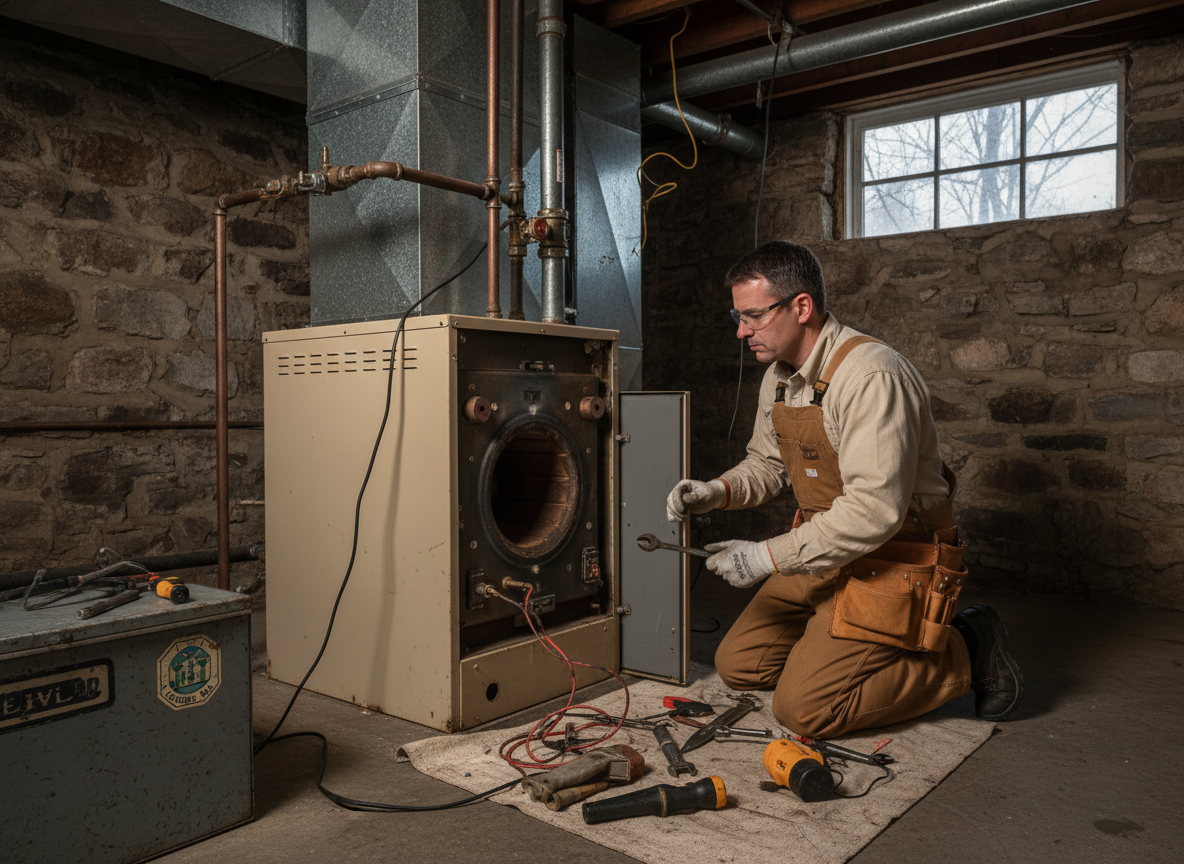
Furnace repair in Lowell starts with the sequence a furnace actually runs, not with a replacement proposal. A gas furnace that will not light, one that fires and quits a minute later, or an electric furnace that runs without warming is a specific fault, and the test order is what separates a real answer from a guessed part.
What furnace repair covers in a Lowell house
The scope runs from the thermostat's call for heat to the last supply register. On a gas furnace that means the low-voltage circuit, the ignition source, the gas valve and manifold pressure, the burners, the inducer and its pressure switches, flame proving, the limit and rollout switches, the control board and the blower.
A repair is different from a maintenance visit in one way that matters. A repair begins with a reported symptom and works backwards to a cause. Maintenance assumes the equipment runs and inspects it. When heat has stopped on a January night in Lowell, the reported symptom is the only reliable starting point.
Some of what decides the outcome lives outside the furnace. Airflow, gas pipe size, the electrical circuit, the flue's route and the return-air path all set whether a furnace can work at all. A unit that trips its high limit on every cycle is often short of air rather than short of heat.
Signs that point to the furnace rather than the thermostat
No heat at all is the plainest symptom, and on gas equipment it usually resolves to one of five things: no call from the thermostat, no ignition, no flame proving, no draft through the inducer, or no gas at the valve. Each is testable in a few minutes with a meter and a manometer.
A furnace that fires and then shuts down after a minute or two is a different problem. A flame sensor coated in oxide stops proving flame, so the board closes the gas valve as a safety measure. A pressure switch that never closes, a blocked condensate trap on a condensing unit, or a flue that cannot draft will produce the same short run from three unrelated causes.
Short cycling has a quieter cause as well. A furnace sized for a larger load heats the house quickly, satisfies the thermostat and stops, then repeats. In a Lowell triple-decker the same pattern can come from a thermostat in the wrong flat, a return grille sized for a smaller unit, or a filter that has not been changed since the previous tenant.
Noises are diagnostic. A boom or thud at ignition is delayed ignition, where gas has collected before it lights. A screech at start-up points at a blower bearing. A rattle that follows the inducer is often a loose vent connector.
Smells need sorting rather than guessing. The dusty smell on the first run of the season is normal and burns off within an hour. A metallic or overheated smell, gas at the cabinet, or exhaust that leaves soot at the flue collar are not normal.
How a repair visit runs
The visit opens with the complaint in the owner's words: no heat, heat that comes and goes, air that never gets hot, a noise, a smell, a breaker that will not stay set, or a thermostat calling with nothing happening. The address and the equipment type narrow the first checks before anyone arrives, and in Lowell the age and type of building narrows them further, because a basement furnace in a 1900 triple-decker and a closet unit in a converted mill are reached and vented in completely different ways.
On site the data plate is recorded first: make, model, capacity, fuel, age and system type. Then the thermostat and filter, because a flat battery or a filter loaded with pet hair imitates an electrical fault convincingly. Then the sequence is tested in order, supply, call for heat, ignition or elements, flame proving or limit circuit, airflow and finally the safety devices, with temperature rise measured across the heat exchanger rather than assumed from the supply temperature alone.
The confirmed fault is then described in plain terms, along with what it means for the rest of the system. Where a repair and a changeout are both defensible, both are set out with what each assumes about the age and condition of what is already installed. Nothing further is started until that explanation has been heard.
What a repair visit includes
The work is not a single part swap. A repair visit covers the control circuit and transformer, the ignition source and flame sensor, the gas valve and manifold pressure, burner condition, the inducer and its pressure switches, the limit and rollout circuit, the blower and its capacitor, the flue and vent connector, the condensate trap and drain on a condensing furnace, and the filter and return-air path. Each is checked because each can produce the same complaint.
Where a safety device has opened, the device is not simply reset and left. A rollout switch that has tripped has done so because flame left the heat exchanger, and the cause behind it has to be found before the switch is put back in service. The same applies to a high limit that has opened on temperature: resetting it without correcting airflow turns a repair into a repeat visit.
The visit ends with a full heating cycle, a temperature-rise reading inside the range on the data plate, a check that the furnace shuts down cleanly and restarts on its own, and a short written summary of what was found and what was done. Old parts are shown where seeing them helps, and the space is left as dry and as clean as it was found.
The Lowell conditions that shape the diagnosis
Lowell's heating season is long enough to expose weaknesses that a milder climate would hide. NOAA's 1991-2020 normals for the Lowell station put the normal January low at 16°F and the normal high at 34°F, with 1,243 heating degree days in that month alone. Equipment here runs hard for five months, and a marginal capacitor or a partly blocked flue that would survive a short season elsewhere tends to fail in the first cold snap.
Snow is part of the diagnosis rather than the weather report. The Bedford station that supplies the region's snowfall normals averages 59 inches in a normal year, 16 inches of it in January. High-efficiency furnaces vent through sidewall PVC terminations, and a drift that buries the intake or ices over the exhaust will shut a furnace down or, worse, push exhaust back into the cabinet. A no-heat call after a storm is often a venting call.
The housing stock decides how the work is reached. Lowell's three-deckers stack three flats with a furnace or an air handler per floor, a shared chimney and a basement that is also the mechanical room. Older units draw combustion air from the basement itself, so a dryer, a bathroom fan or a second furnace starting up can reverse the draft on a naturally vented appliance. Mill conversions downtown put equipment in closets and on roofs, with vent runs through historic fabric and no straight path to the outside.
Tenure matters too. In the 2020-2024 American Community Survey, 43.2% of Lowell's occupied homes were owner-occupied, which means most flats in the city are rented. A repair in a rented flat has to be explained to whoever pays for it, often a landlord who is not on site, and the summary at the end of the visit is written with that in mind.
Fuel changes the order of the checks. Lowell's older neighbourhoods carry gas furnaces alongside oil-fired equipment and electric resistance heat, and the same complaint means different things on each. A gas furnace that will not light is an ignition question; an oil furnace that will not light is a nozzle, filter, pump or transformer question; an electric furnace that runs cold is a sequencer or element question. Diagnosing one as the other is how parts get ordered twice.
Where repair stops and replacement starts
Some findings are not repairable, and saying so early is part of the job. A heat exchanger that has cracked through, a flue that has rusted from the inside, a cabinet rotted where condensate has run, or a control board that no longer exists for a thirty-year-old unit all change the decision. So does a furnace that has been repaired three times in two winters for three different faults, because the pattern matters more than any single failure.
It is equally true that replacement is proposed too quickly. A furnace that trips its limit because a return duct is crushed under a floor joist does not need a new furnace. A unit that shuts down on a pressure switch because the condensate trap is full of debris does not need a new furnace either. The test results decide, and they are shown rather than summarised.
Related furnace work covered here
Furnace repair on this site includes the ignition and flame-sensing circuit on gas equipment, the sequencer and element circuit on electric equipment, blower and airflow faults, limit and rollout conditions, thermostat and control wiring, venting and combustion air, and condensate handling on condensing units. Each of those is a section of the same visit rather than a separate service.
Systems that are not furnaces are outside this page. A house heated by radiators and a boiler, or by a heat pump with an outdoor unit, needs a different diagnosis and a different set of tests, and pretending otherwise would waste the visit. Where the equipment turns out to be one of those, the finding is explained and the work stops there.
The next step
The contact page carries the business address at 90 Elliott Drive, Lowell, MA 01852, USA, and the areas covered from it. Describe what the heat is doing, when it started, whether the thermostat is calling, and the make and model if the data plate is readable, and the visit can be planned around the right equipment rather than a general call.
Furnace Repair Services We Offer
✓Gas Furnace Diagnosis
Ignition, flame proving, gas pressure, draft and the safety circuit, tested in sequence rather than by substitution.
✓Electric Furnace Diagnosis
Sequencers, elements, limits and blower staging on resistance heat, including the circuits that feed them.
✓Ignition and Flame-sensing Faults
Hot-surface igniters, spark ignition, flame sensors and the boards that read them, including the oxide film that stops a sensor proving flame.
✓Blower and Airflow Faults
Blower motors, capacitors, wheels and the return path, because a starved furnace imitates several electrical faults at once.
✓Limit and Rollout Conditions
High-temperature limits and rollout switches, with the cause of the trip found before anything is reset.
✓Thermostat and Control Wiring
Thermostat calls, batteries, low-voltage wiring and the board terminals that carry the call to the furnace.
✓Venting and Combustion Air
Flue connectors, sidewall terminations, induced draft and the combustion air a basement furnace shares with other appliances.
✓Condensate and Drain Handling
Traps, pumps and drain lines on condensing furnaces, including the frozen or debris-blocked trap that looks like a pressure-switch failure.
How it works
- 1
Take the complaint seriously
No heat, heat that quits, air that never warms, a noise or a smell. The symptom and the system type set the first tests, and the address sets what kind of building the equipment sits in.
- 2
Record the equipment
Data plate details, fuel, age, venting arrangement and where the furnace sits. A basement unit, a closet unit and a rooftop unit are three different visits.
- 3
Test in sequence
Thermostat call, control voltage, ignition or elements, flame proving or limits, airflow and safety devices, with temperature rise measured rather than guessed.
- 4
Explain before touching
The confirmed fault is described in plain terms, and where repair and replacement are both defensible, both are set out with what each assumes.
- 5
Do the agreed work
Power and gas isolated, the work area protected, the failed part shown where it helps, and no safety device reset without the cause behind it corrected.
- 6
Prove it and hand over
A full heating cycle, a temperature rise inside the data-plate range, a clean shutdown and restart, and a written summary for whoever pays for the work.